Charting Our Own Course: The Canadian Communities Building Delivery Networks That Don't Answer to Amazon

For years, the dominant narrative around Amazon has been one of inevitability. The platform is too large, too fast, too deeply embedded in Canadian consumer habits to be meaningfully challenged. The argument goes that convenience has already won, and that local alternatives simply cannot compete with next-day delivery and frictionless returns.
That narrative is wrong. And the communities proving it wrong are worth knowing.
Across this country, grassroots organisers, co-operative entrepreneurs, and civic-minded technologists are constructing something remarkable: locally owned, community-accountable logistics and e-commerce infrastructure that does not funnel value to a distant shareholder class. These are not utopian experiments. They are functioning models, and they are growing.
Vancouver Island's Co-operative Delivery Collective
On Vancouver Island, where geography has always complicated commerce, a coalition of small business owners and residents launched the Island Collective Delivery Network in 2022. The initiative began as a informal arrangement among a handful of independent retailers in the Comox Valley who were losing customers to Amazon's Prime delivery promises. Rather than compete individually, they pooled resources.
The model is straightforward: participating businesses share a fleet of electric cargo vehicles and a unified dispatch system managed by a worker co-operative. Orders placed through member businesses — a local bookshop, a natural foods store, a hardware co-op — are consolidated and delivered on scheduled routes. Delivery fees are minimal, and a portion of every transaction is reinvested into the collective's infrastructure fund.
By 2024, the network had expanded to include over 40 member businesses across three municipalities. "We stopped asking how we could compete with Amazon and started asking how we could make Amazon irrelevant," says one of the founding members, a bookseller who declined to be named for fear of retaliatory algorithmic suppression of her store's online listings. "When your neighbours can get their purchases delivered the same day by someone they know, from a business that employs people in their community, the comparison with Amazon stops being flattering to Amazon."
Parkdale's Neighbourhood Marketplace Experiment
In Toronto's Parkdale neighbourhood, a different model has taken root. The Parkdale Community Market — an online platform built and maintained by a volunteer-led non-profit — functions as a hyper-local e-commerce hub connecting residents with independent vendors within a defined geographic radius.
Unlike Amazon's marketplace, which extracts fees of up to 45 percent from third-party sellers while simultaneously competing against them with private-label products, the Parkdale platform charges a flat annual membership fee and takes no commission on individual transactions. Vendors retain full control of their pricing and inventory. The platform's code is open-source, and its governance is democratic — member businesses vote on platform policy changes.
The initiative has inspired similar projects in Hamilton, Kitchener-Waterloo, and Halifax, each adapted to local context but sharing the same foundational principle: that the infrastructure of community commerce should be owned by the community.
"Amazon's marketplace model is essentially a toll road," says Adaeze Okonkwo, one of the Parkdale platform's lead developers. "Every transaction that passes through it generates revenue for Amazon, regardless of whether Amazon contributed anything to that transaction. We are building public transit instead."
Québec's Regional E-Commerce Coalition
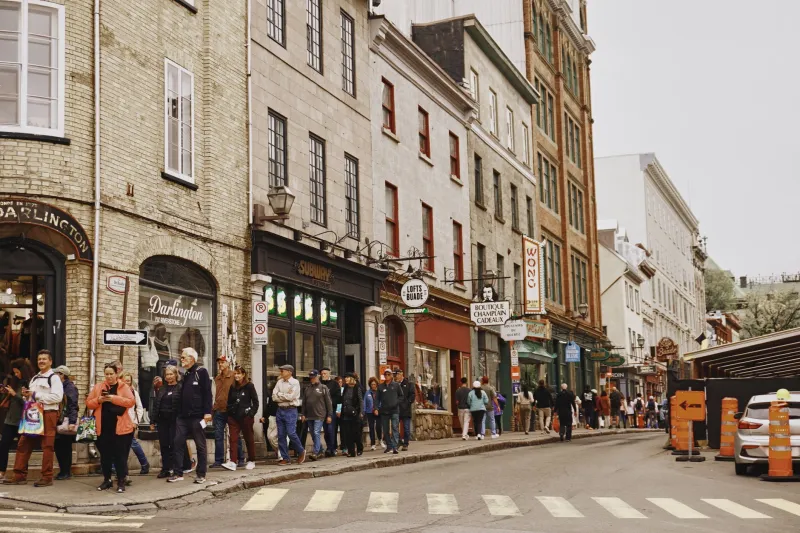
In Québec, where cultural distinctiveness has historically fostered stronger resistance to homogenising corporate forces, a coalition of regional chambers of commerce launched the Achetez Québec digital platform in partnership with several municipal governments. The platform aggregates product listings from thousands of Québec-based independent retailers, offering a unified shopping interface with province-wide delivery coordination.
What distinguishes the Achetez Québec model is its integration with existing postal and regional carrier infrastructure. Rather than building a proprietary logistics network from scratch, the coalition negotiated preferential rates with Canada Post and regional carriers, making delivery costs competitive with Amazon Prime for many product categories.
The platform has processed over $12 million in transactions since its launch, with participating retailers reporting meaningful increases in online sales. Critically, those sales remain within the provincial economy — generating tax revenue, sustaining employment, and keeping commercial relationships local.
The Prairies: Community-Supported Commerce
In Saskatchewan and Manitoba, where rural geography presents particular challenges for local commerce, a network of agricultural co-operatives has expanded its mandate to include general retail logistics. Building on the co-operative tradition that has shaped Prairie economies for over a century, the Prairie Goods Collective now coordinates delivery of locally produced and independently retailed goods across a network of rural communities.
The model borrows conceptually from community-supported agriculture: residents purchase seasonal "shares" in the collective, which are redeemed for goods from participating local businesses. The predictable demand this generates allows the collective to plan delivery routes efficiently, reducing per-unit logistics costs to levels that are genuinely competitive with Amazon.
"Our grandparents built the wheat pools because no individual farmer could negotiate fair terms with the railways alone," says collective coordinator Brenda Whitehorse, based in Saskatoon. "We are doing the same thing. The platform is the new railway, and we are building our own."
How You Can Support — or Start — a Local Alternative
The initiatives profiled here did not emerge from nowhere. They were built by residents who decided that frustration was not enough — that resistance required construction. For Canadians who wish to support or replicate these models, several pathways are available:
Support existing alternatives. Seek out local e-commerce platforms and community delivery networks in your region. Prioritise them even when the experience is slightly less seamless than Amazon. Your tolerance for imperfection is an investment in a better system.
Organise locally. Business improvement associations, neighbourhood councils, and local chambers of commerce are natural convening bodies for conversations about shared logistics infrastructure. The Vancouver Island and Parkdale models both began with a small group of people in a room asking a simple question: what would it look like if we did this ourselves?
Advocate for public investment. Municipal and provincial governments have both the mandate and the fiscal capacity to invest in community commerce infrastructure. Demand that your elected representatives treat local logistics as a public good rather than leaving it to be captured by a single private corporation.
Choose Canada Post. The crown corporation's delivery network reaches every address in the country and its revenues sustain thousands of unionised Canadian jobs. Whenever possible, choose retailers who ship through Canada Post.
The infrastructure of commerce is not a natural monopoly. It is a political choice. And Canadians are beginning to choose differently.