Convenience's Hidden Landfill: The Environmental Deception Buried Inside Amazon's Return Policy
Amazon's return policy is one of its most effective marketing tools. "Hassle-free returns" and "free returns on millions of items" are promises that appear prominently in the company's advertising and are frequently cited by Canadian consumers as a primary reason for choosing the platform. The implicit message is one of risk-free shopping: if it doesn't work out, simply send it back.
What happens after you send it back is a story Amazon would prefer you did not examine too closely.
The Reverse Logistics Reality
The economics of Amazon's return system are, from an environmental standpoint, catastrophic. When a consumer returns an item through the platform, that item enters what the logistics industry calls a "reverse supply chain" — a process of sorting, evaluation, repackaging, and redistribution that is vastly more expensive and resource-intensive than forward shipping.
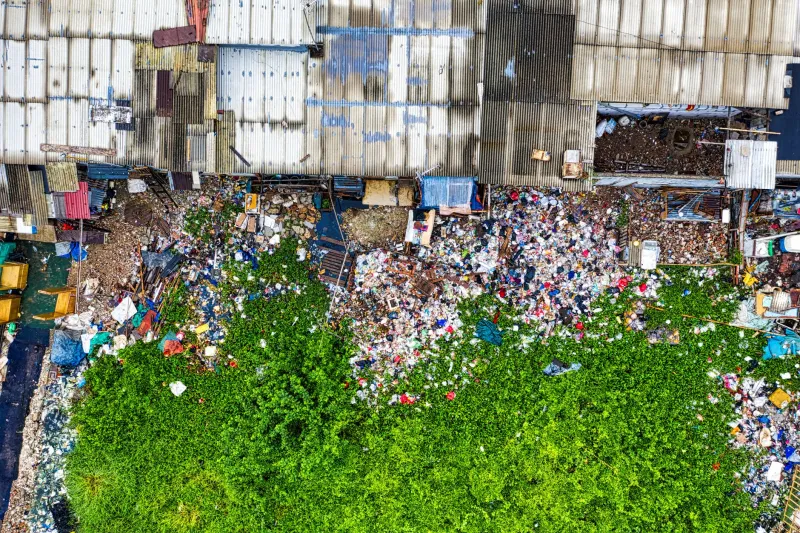
For a significant proportion of returned goods, the calculus is straightforward for Amazon: it costs more to process, repackage, store, and resell a returned item than the item is worth. In these cases — and industry analysts estimate they account for between 25 and 30 percent of all returns on high-volume e-commerce platforms — the item is not restocked. It is destroyed.
A 2023 investigation by the CBC's Marketplace programme documented Amazon return goods appearing at Canadian liquidation warehouses and, in some cases, being confirmed as destined for incineration or landfill by warehouse workers who spoke on condition of anonymity. Similar findings have been reported by investigative journalists in France, Germany, and the United Kingdom, where regulatory attention to the practice has been more sustained.
In Canada, where municipal waste management data is collected provincially and often incompletely, the precise volume of Amazon return goods entering the waste stream is difficult to quantify. However, extrapolating from American data — where Amazon processes an estimated 200 million returns annually — and adjusting for Canada's approximately ten percent share of Amazon's North American customer base, a conservative estimate suggests that tens of millions of returned items enter the Canadian waste stream or are incinerated each year.
The Sustainability Illusion
Amazon's public-facing environmental commitments are extensive and elaborately presented. The company's "Climate Pledge" commits to net-zero carbon emissions by 2040. Its "Second Chance" programme, launched in Canada in 2021, purports to facilitate the donation and resale of returned goods rather than their disposal. Its packaging reduction initiatives are regularly highlighted in corporate communications.
Environmental researchers who have examined these commitments in detail describe them as a form of greenwashing — a pattern in which superficially credible sustainability messaging is used to obscure practices that are fundamentally incompatible with genuine environmental responsibility.
"The Second Chance programme is real, but it is marginal," says Dr. Fatima Al-Rashid, an environmental policy researcher at Dalhousie University who studies corporate sustainability claims in the retail sector. "The volume of goods that programme processes is a fraction of the total return stream. The headline commitment to sustainability and the operational reality of mass disposal exist in parallel, and the company makes no serious effort to reconcile them."
The fundamental tension is structural. Amazon's return policy is designed to reduce the psychological friction of purchasing — to make buying feel consequence-free. That design imperative is incompatible with genuine environmental stewardship, because consequence-free purchasing generates consequence-laden waste.
What Local Retailers Do Differently
The contrast with independent Canadian retailers is instructive. For a small business, a returned item represents a direct financial loss that cannot be absorbed through the economies of scale available to a trillion-dollar corporation. This constraint has driven local retailers to develop return practices that are, almost by necessity, more environmentally responsible.
Many independent Canadian retailers operate explicit circular economy models. A Toronto-based children's clothing retailer, for example, accepts returns only in exchange for store credit, incentivising customers to think carefully before purchasing and ensuring that returned items are resold within the store's own inventory. A Vancouver outdoor equipment shop operates a formal gear repair and refurbishment programme, extending the life of returned items and selling them as certified second-hand goods at reduced prices.
These are not exceptional practices. They are the ordinary adaptations of businesses that cannot afford to treat returned goods as disposable. And they produce substantially less waste as a result.
"When you shop local, the person accepting your return is the same person who ordered that item, priced it, and put it on the shelf," says Marguerite Tremblay, co-owner of a Montréal independent housewares shop and a member of the Conseil québécois du commerce de détail. "They have every incentive to find that item a new home rather than throw it away. Amazon has no such incentive. The item is anonymous to them."
Canada's Waste Management Gap
Canada does not currently have federal legislation specifically regulating the disposal of returned consumer goods by e-commerce platforms. The European Union has moved to ban the destruction of unsold and returned consumer goods, with implementation beginning for large companies in 2026. No equivalent regulatory framework exists in Canada, leaving the practice effectively unregulated.
Environment and Climate Change Canada has acknowledged the issue in general terms but has not committed to specific legislative action. Provincial environment ministries, which bear primary responsibility for waste management regulation, have similarly failed to address the e-commerce return disposal problem with any specificity.
This regulatory vacuum suits Amazon well. In the absence of disclosure requirements, the company is not obligated to report the volume of returned goods it destroys in Canada. In the absence of disposal prohibitions, it faces no legal consequence for the practice. And in the absence of public awareness, it continues to benefit from a sustainability reputation that its operational practices do not support.
Demanding Accountability
For Canadian consumers and advocates, several avenues for pressure are available.
First, the regulatory gap must be closed. Canadians concerned about the environmental impact of e-commerce waste should contact their Members of Parliament and provincial environment ministers to demand disclosure requirements and disposal prohibitions comparable to those being implemented in Europe.
Second, the purchasing decision itself is a form of environmental action. Every item purchased from a local independent retailer — particularly one with an explicit circular economy model — is an item that will not enter Amazon's return-to-landfill pipeline. Shopping locally is not merely an economic act. It is an ecological one.
Third, Amazon's sustainability messaging should be challenged wherever it appears. When the company sponsors environmental initiatives or promotes its Climate Pledge, the question of what happens to 25 percent of its returned goods deserves to be part of that conversation.
Convenience has a cost. In Canada, part of that cost is measured in tonnes of discarded goods, in emissions from incineration, and in the slow filling of landfills with items that were purchased, returned, and quietly disappeared. It is time to make that cost visible.